

This Year 1 multiplication and division lesson is written for pupils aged 5-6 and follows the National Curriculum. In short, it shows you how to solve one-step problems by making equal groups, doubling and sharing. Before you start, it helps to revise addition and subtraction within 20 and missing number problems, because this lesson builds on them.
Year 1 multiplication and division lesson: what you will learn
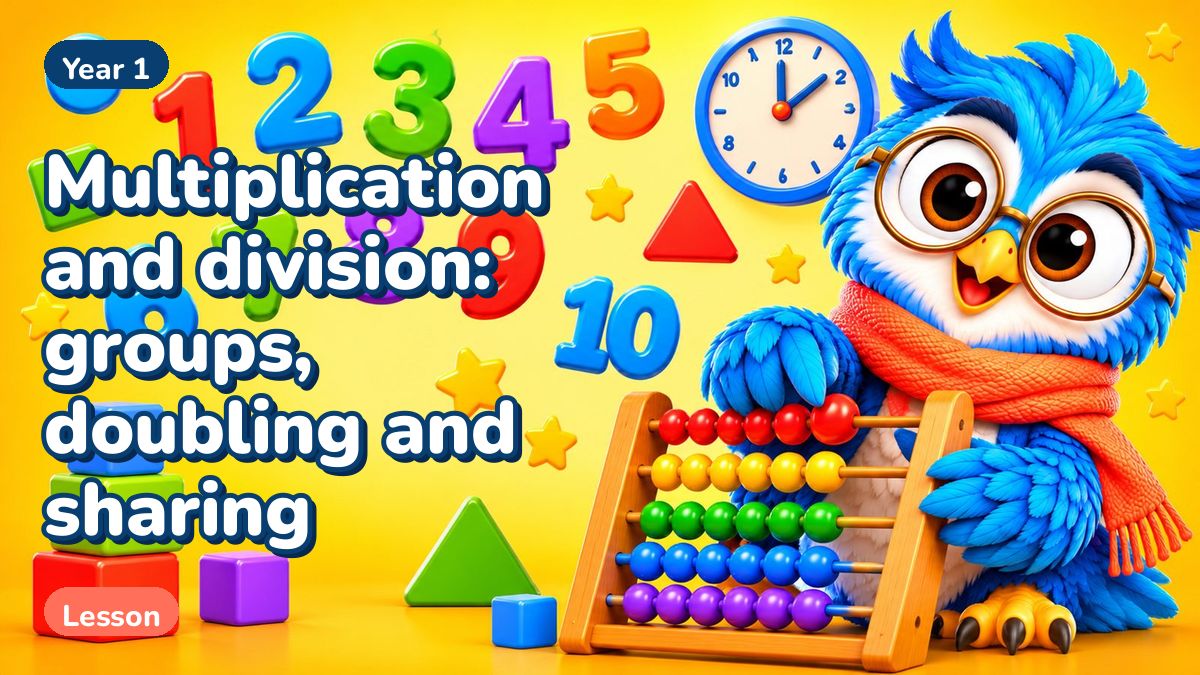
Hello, I am Otto! Today we learn three clever ideas: making equal groups, doubling and halving, and sharing. These ideas are the start of multiplication and division. You will find them everywhere, from sharing a pizza to packing eggs.
Starter activity
Get 12 counters. Make groups of 2. How many groups do you make? Now make groups of 3 with the same 12 counters. How many groups now? Finally share the counters between 4 friends so that each gets the same number. How many does each friend get?
Equal groups
Definition: equal groups
Equal groups have the same number of things in each group. If there are 3 bags with 4 apples in each bag, there are 3 equal groups of 4.
3 groups of 4. We count in fours: 4, 8, 12. There are 12 dots in all.
Rule: adding equal groups
When groups are equal, you can add the same number again and again. 3 groups of 4 means 4 + 4 + 4 = 12. This is the same as counting in steps of 4. Later you will write this as 3 × 4 = 12. We say "3 times 4 equals 12".
Example 1
There are 5 plates. Each plate has 2 cakes. How many cakes are there?
Count in twos: 2, 4, 6, 8, 10. There are 10 cakes.
Counting in steps
Counting in steps helps with equal groups. Count in 2s for pairs, such as socks or shoes. Count in 5s for fingers on hands. Count in 10s for tens. Say the numbers out loud and keep a count of the steps on your fingers.
| Counting in | Numbers |
|---|---|
| 2s | 2, 4, 6, 8, 10, 12, 14, 16, 18, 20 |
| 5s | 5, 10, 15, 20, 25, 30, 35, 40, 45, 50 |
| 10s | 10, 20, 30, 40, 50, 60, 70, 80, 90, 100 |
Example 2
How many fingers are on 4 hands?
Each hand has 5 fingers. Count in fives, 4 times: 5, 10, 15, 20. There are 20 fingers.
Arrays
Definition: array
An array is objects arranged in neat rows and columns. Each row has the same number of objects.
This array has 3 rows with 5 in each row. Count in 5s: 5, 10, 15. There are 15 dots.
Example 3
A box of chocolates has 2 rows of 6 chocolates. How many chocolates are there?
Count in 6s: 6, 12. Or add: 6 + 6 = 12. There are 12 chocolates.
Doubling
Definition: double
To double a number means to make it twice as big. It is the same as adding the number to itself. Double 4 is 4 + 4 = 8.
Key fact: doubles to know
- Double 1 is 2, double 2 is 4, double 3 is 6, double 4 is 8, double 5 is 10.
- Double 6 is 12, double 7 is 14, double 8 is 16, double 9 is 18, double 10 is 20.
Example 4
A ladybird has 6 spots on one wing. It has the same on its other wing. How many spots does it have in all?
Double 6 = 6 + 6 = 12 spots.
Halving and sharing
Definition: half and sharing
To halve a number means to share it into 2 equal groups. Sharing means giving the same number to each person. Half of 10 is 5, because 5 + 5 = 10.
Method: sharing equally
- Draw the right number of plates or circles.
- Share the objects one at a time, one for each plate.
- Count how many are on each plate. Check that they are all the same.
- Check that nothing is left over (unless the problem says so).
Example 5
Share 12 sweets equally between 3 children. How many does each child get?
Give one sweet to each child again and again until all 12 are gone. Each child gets 4 sweets. Check: 4 + 4 + 4 = 12.
Example 6
Half of 14 is what number?
Share 14 between 2: 7 and 7. Half of 14 is 7. Check: 7 + 7 = 14.
Example 7: grouping
There are 15 children. They make teams of 5. How many teams are there?
Count how many 5s fit in 15: 5, 10, 15. That is 3 fives. There are 3 teams.
Watch out
- In equal groups, every group must be the same size.
- Do not forget to count the groups as well as the objects.
- Sharing is not fair if one person gets more. Check each plate.
Did you know?
The sign for times, ×, was first used about 400 years ago. Before that, people wrote long words. Counting in twos is very old. Farmers counted sheep in pairs, and people counted in tens because we have ten fingers.
Otto’s tip
Draw a picture. A drawing of the groups, the plates or the rows makes every problem easier. And remember: count in steps for speed!
How to use this Year 1 multiplication and division lesson
First, read the key points so that you know where the Year 1 multiplication and division lesson is going. Then work through each definition and worked example, and cover the solution before you read it. After that, practise with the multiplication and division: groups, doubling and sharing worksheet and check every question with the worksheet answers. When you feel ready, test yourself with the multiple choice questions or the quick quiz. Finally, sit the multiplication and division: groups, doubling and sharing test and mark it with the test answers.
Also, the starters are a good warm-up, so you can keep the key facts fresh. Moreover, all the pages of this chapter work together, so you can move between them at any time. For example, many pupils read the lesson on Monday, practise on Wednesday and test themselves on Friday. In short, this Year 1 multiplication and division lesson gives you everything you need for the chapter.
To sum up, regular practice works better than one long session. For instance, ten minutes a day is often enough. Besides, mistakes are useful, because they show what to revise next. Then, once a method feels easy, try a harder question. As a result, you build confidence step by step.
Similar pages
 WorksheetMultiplication and division: groups, doubling and sharing – Year 1 maths worksheet with answers to download as PDF
 AnswersMultiplication and division: groups, doubling and sharing – Year 1 maths worksheet answers to download as PDF
 Multiple choice questionsMultiplication and division: groups, doubling and sharing – Year 1 maths multiple choice questions to download as PDF
 QuizMultiplication and division: groups, doubling and sharing – Year 1 maths quiz to download as PDF
 TestMultiplication and division: groups, doubling and sharing – Year 1 maths test to download as PDF
 Test answersMultiplication and division: groups, doubling and sharing – Year 1 maths test answers to download as PDF
 StartersMultiplication and division: groups, doubling and sharing – Year 1 maths starters to download as PDF
Other chapters in this level
 LessonNumbers to 20 and counting – Year 1 maths lesson to download as PDF
 LessonNumbers to 100 and place value – Year 1 maths lesson to download as PDF
 LessonAddition and subtraction within 20 – Year 1 maths lesson to download as PDF
 LessonMissing number problems – Year 1 maths lesson to download as PDF
 LessonFractions: halves and quarters – Year 1 maths lesson to download as PDF
 LessonLength, mass and capacity – Year 1 maths lesson to download as PDF
 LessonTime and money – Year 1 maths lesson to download as PDF
 Lesson2D and 3D shapes – Year 1 maths lesson to download as PDF